
Benin Coup Plot Foiled by Loyal Forces and Regional Allies, ECOWAS Deploys Standby Troops
Credit:
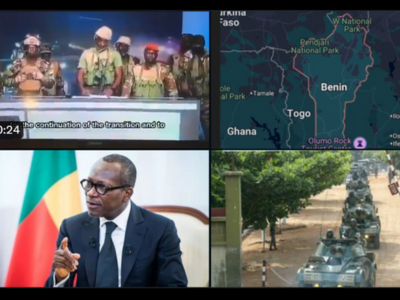
Benin’s government and armed forces, backed by Nigerian airstrikes and French support, swiftly crushed an early-morning coup attempt on Sunday led by mutinous soldiers who briefly seized state television to announce President Patrice Talon’s ouster.
Within hours, loyalist forces regained control, and regional bloc ECOWAS ordered the immediate deployment of a multinational standby force to bolster Benin’s defenses amid fears of instability spilling over from the Sahel.
Interior Minister Alassane Seidou declared in a televised address that loyalist troops had neutralized the threat from “a small group of soldiers” intent on destabilizing the state. Talon, 67, appeared on national TV later that evening, assuring citizens the situation was “totally under control” and vowing punishment for the plotters. He urged calm ahead of April’s presidential election, his last after two terms marked by economic reforms and criticism over political restrictions.
The coup faction, calling itself the “Military Committee for Refoundation” and led by Lt. Col. Pascal Tigri, broadcast a manifesto dissolving parliament, closing borders, and imposing a curfew. They accused Talon of neglecting troops battling jihadist incursions from Niger and Burkina Faso, cutting healthcare programs such as state-funded dialysis, raising taxes, and curbing opposition ahead of polls. Gunfire near the presidential palace prompted embassy alerts from France, the U.S., and Russia, advising citizens to shelter in place.
Benin’s army, reinforced by external aid, regained control quickly. Flight data confirmed three Nigerian aircraft—two fighter jets—entered Beninese airspace from Lagos, striking rebel positions at the TV station and a military camp. A French plane circled overhead, though diplomats denied reports that Talon sought refuge at their embassy.
Nigerian President Bola Tinubu’s office confirmed the intervention followed urgent requests from Talon, with ground troops dispatched under Beninese command. Air Commodore Ehimen Ejodame, NAF spokesperson, stressed that operations aligned with ECOWAS protocols to prevent “spillover threats” to regional borders.
By afternoon, authorities reported 12 to 14 arrests, including Tigri and alleged Burkina Faso-linked infiltrators. Officials said no wider military backing existed for the rebels, and Cotonou streets, initially tense with patrols, returned to relative calm. No casualties were officially confirmed, though explosions from airstrikes rattled the city.
ECOWAS, already reeling from recent coups in Mali, Guinea, Burkina Faso, Niger, and Guinea-Bissau, condemned the “subversion of the people’s will” and activated its standby force under the 1999 Conflict Prevention Protocol. Troops from Nigeria, Sierra Leone, Ghana, and Ivory Coast will support Benin’s “constitutional order and territorial integrity.” The African Union echoed the rebuke, pledging aid for democratic restoration, while UN envoy Leonardo Santos Simão expressed solidarity and urged protection of civilians.
The coup attempt highlights West Africa’s fragility, where jihadist expansion linked to al-Qaeda and Islamic State has strained armies and fueled dissent. Benin, a rare democratic holdout since ending Marxist rule in 1991, faces northern border threats, with recent soldier losses amplifying grievances. Critics blame Talon’s consolidation of power—such as creating a new Senate and extending mandates—for eroding trust, while supporters credit his infrastructure drive and anti-corruption agenda.
Nigeria, as regional heavyweight, reaffirmed solidarity, calling the coup attempt a “direct assault on democracy.” Yet observers warn that without inclusive governance, such plots risk recurrence, potentially undermining ECOWAS cohesion amid AES defiance.






0 Comment(s)